
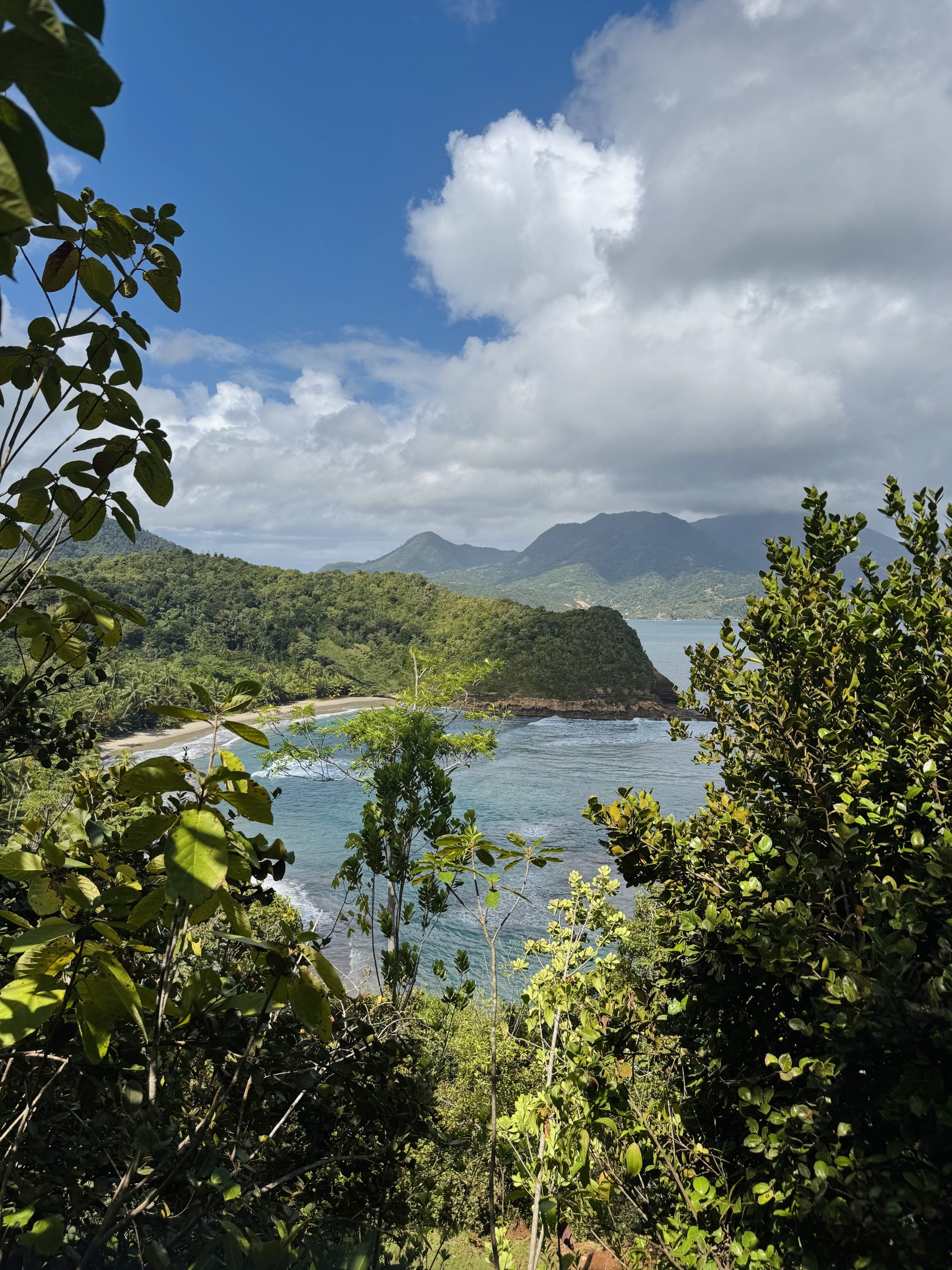

We recently spent 8 magical days on the island of Dominica (pronounced Dom-in-EEK-a), located in the Eastern Caribbean between Guadeloupe and Martinique. It is known as the “Nature Isle of the Caribbean”, and it lives up to that name.
We chose Dominica using a method we use often: We have a few places in mind and then we price out each trip, factoring in travel (airfare, rental car, rideshares, etc.), accommodations, and exchange rate and make our decision based on those factors.
Ok, back to Dominica!
Sixty percent of the mountainous 29-by-16-mile volcanic island is covered by rainforest. There are 365 rivers, dozens of waterfalls, world-class scuba diving, hot springs…It is a gem. It is also grittier and less developed than many Caribbean islands that some tourists are used to. Not dangerous, just developing. Beyond a scattering of small high-end resorts, it’s largely small working-class towns. And the island still bears the scars of Hurricane Maria, which destroyed or badly damaged more than 90 percent of structures in 2017.
Rest assured, we never felt unsafe, and, as you will read below, we repeatedly encountered graciousness and generosity.

Saturday/Day 1
Due to warnings about long lines due to the government shutdown, we arrived at Newark Airport in New Jersey three hours before departure. We made it through security in about half an hour.
Given what turned into a 2-1/2 hour flight delay, plenty of time for reading and emails.
We flew into Douglas-Charles Airport on the northeast coast, one of two airports on Dominica. It is typical of small Caribbean islands: a short landing strip at the water’s edge and a modest terminal set in the rainforest.
Although Dominica has a reputation for challenging driving, particularly for those used to driving with left-side steering on the right side of the road, we wanted to rent a car for maximum freedom. Chris accepted the challenge. Owing to roads that are potholed, quite steep, and sometimes unpaved, rocky, or muddy, especially near backwoods natural wonders, we strongly recommend renting a 4×4 or an AWD vehicle. We rented from Yadah Car Rental at the airport—a very pleasant experience. We paid about $400 for the week for a Subaru Crosstrek.
For navigation, you can use Google Maps or a similar platform, but if you plan to do a lot of driving, we recommend activating an international calling plan so you can research as you go and navigate via Wi-Fi, which is generally good on the island.
Outside of major towns, and often in them as well, roads are narrow and feature recurring, severe hairpin turns on blind corners that leave little or no visibility of oncoming traffic. And in general, folks drive fast. Thus, it is wise to beep at blind corners to announce your presence. There is also often a foot-wide drainage ditch running along the left side of the curbless roads, which adds to the precarity. One tire in that ditch; the car is in the shop.
So the driving can be challenging to get used to, but if you’re a (justifiably) confident driver, it adds to the fun. Just beep at blind corners, avoid the ditch, and pull aside when you can to let faster-moving cars pass.
If you would prefer not to rent a car, you can hire a driver for the day, take a taxi, or hop on the small public buses, though their schedules are reportedly unreliable.

Saturday/Day 1 cont.
The coastal drive north from the airport was beautiful. Just a minute in, we pulled over to take our first pics at a black sand beach overlooking Londonderry Bay. It took about 45 minutes to arrive at our first Airbnb, Niza’s Place, in the small town of Paix Bouche. Because we hadn’t activated our international phone plan, we had a bit of trouble finding the house. While we were pulled over outside of town to get our bearings, a stranger stopped his truck, asked if we needed help, and sent us to the doorstep of a charming little cottage in the hills that would be our home for the next three days. We experienced this level of easy kindness and generosity throughout the trip.
We grabbed a few things at the local grocery shop, where folks helped us find Brigidy, a bar and grill we had read about. Lucky us, it turns out that the national domino quarterfinals were being held there that night, so we got to watch the competition, with running commentary from one of the coaches, while we waited for BBQ wings, fried fish, and French fries to go. Just the kind of chance experience we love on these trips.
We drove through the pitch-black to the Airbnb, enjoyed the delicious takeout–especially the wings–and made rum cocktails with pineapple and grapefruit juice, as recommended at the grocery shop.
We decided not to drive in the dark again because of the winding roads and limited visibility. The sun sets at about 6:15, so each night we made sure to get back by then to shower, hang out, read, and retire early for an early start.

Sunday/Day 2
Batibou Beach, about 15 minutes from our Airbnb, is said to be one of the island’s most beautiful beaches. You can take the very pretty downhill walk from a small roadside parking lot through lush rainforest, less than a mile, or drive if you have AWD or better. There’s an entry fee of $5 US per person, payable at the beach.
The entrance to the beach from the rainforest is dramatic. Batibou Beach is postcard-perfect, one of the prettiest we’ve seen. Horseshoe white-sand beach, palm trees, and a reef in the near distance. (Unfortunately, the water was a bit choppy that day for snorkeling, but it was still good for a dip.) There are a handful of picnic tables, a swing suspended from a palm tree, and a food stand that, unfortunately, was not open when we were there. No restrooms.
We waded, swam, lounged, and explored. On one end of the horseshoe, we climbed among a series of tidepools to check out the critters–crabs, snails, fish, eels–and at the other, we walked a rocky path along the water’s edge that curls around to a blowhole, waves exploding across the rocks—a great spot for photos. Wear water shoes, expect to get wet.
Bonus: There were maybe five people at the beach when we arrived at around 10 am, fewer than 25 when we left at around 2 pm.
A couple of things about Batibou: bring a snack and drinking water. We couldn’t find the bakery we were looking for on the drive there, but we thought we’d be fine since we had read that the family who owns the surrounding land serves home-cooked food from a beachside stand.
On that day, the food didn’t materialize until we were walking out. But again, the kindness of strangers: a couple at the beach gave us some of their homemade food, including some amazing banana bread, to tide us over.
Loved Batibou Beach.
That $5 fee? All beaches in Dominica are public, but the family that owns the beautiful forested property surrounding Batibou uses the funds to maintain the site. And they do a great job. The beach is spotless. The rub? Our gracious food donors said that investors have been exerting great pressure on the family to sell the property. So at some point, Batibou might go from blissed-out natural paradise to high-end resort. Get there before that happens.

Sunday/Day 2 cont.
Because we had barely eaten, lunch was a priority. We wanted to eat at Red Rock Cuisine, in nearby Calibishie, and then explore the namesake Red Rock formations along the coast. It took us a few tries to find the restaurant – even with coordinates – and then we found that the kitchen was not serving food that afternoon. (We encountered both scenarios a few times, so note to self.)
The bartender recommended a few places nearby, and we ended up at Unique Seaview Restaurant, where we sat in an outdoor area by the water. Service was friendly, and the food was quite good: mahi-mahi kebabs, pineapple curry chicken, and fried lionfish. Each dish came with several sides, including plantains, salad, lentils, and rice.
We returned to Red Rock Cuisine for their signature (and strong and delicious) Red Rock Rum Punch, made with sorrel and fruit juices. We brought our drinks on a short walk from the restaurant to the striking orange-red rock formation, composed of volcanic ash and clay. Great fun walking around the formation, which is absolutely stunning against the deep-blue Atlantic. Beautiful views of the coastline.
We paid for the drinks and the $2 US entry fees on the way out.

Monday/Day 3
We started the day with a 20-minute drive west to Portsmouth, the second most populous town in Dominica, with a whopping 3,600 residents. After a breakfast of ham-and-cheese paninis and eggs, bacon, and sausage at a little seaside spot called Maford House Cafe–lots of roosters and cute puppies about, and a beautiful view–we headed to one of the few resorts on the island, where we had a day pass.
We had a relaxing time poolside, but it wasn’t nearly as satisfying as exploring on our own. Also, having just returned from The Four Seasons in Nevis, Trae was underwhelmed.

Monday/Day 3 cont.
We headed to Ripaton Beach to check out the rusted hull of the Grace Kelly, which was shipwrecked at the shore in Hurricane Maria in 2017. Then we walked down the beach in the rain to check out a smaller shipwreck. There is no sign on the road for the beach, so it’s easy to miss, but it’s worth backtracking when you pass it.
We had read about great snorkeling off the beach at the luxury Secret Bay resort up the road, so we gave that a shot, but we were told at the gate that it was too crowded at the moment and to come back another time.
After a tasty snack of chicken pockets, pork dumplings, breadfruit, and bottled cocktails at nearby Harbor Bites restaurant, we stumbled upon an abandoned resort, which we explored for a bit. Herons were mingling with dozens of goats that were grazing on the grounds, some standing on two legs to pull leaves from low-lying trees.
Then we headed to Toucari Bay, a popular snorkeling spot known for high visibility and champagne-like bubbles emanating from the seafloor. That drive had some of the tightest, steepest switchbacks and blind corners we’d seen, and that’s saying a lot. Not for the faint of heart. The beachside area was gritty but quaint, dotted with a few restaurants/bars. We hung out at the black-sand beach, and Chris and Sadie took a quick dip with their snorkel masks. But, we had to head back before nightfall and thus didn’t do a proper snorkel. Later in the week, we met a couple who said they had enjoyed a great afternoon there with their 3-year-old son.
Back in Paix Bouche, the only full-on restaurant in the immediate area, Brigidy–site of the dominoes tourney–was closed, so we stopped at the grocery shop and picked up provisions for home cooking, and had a pleasant night on the patio. The next day, we would head Southwest to our second Airbnb.

Tuesday/Day 4
First stop on our drive south, Chaudiere Pool, a remote swimming hole on the Hampstead River in Saint Andrew Parish, a 35-minute drive from our Airbnb in Paix Bouche. In the village where you take the bumpy road to the pool, Ministry of Tourism staff collect a $10 EC ($3.70 US) per-person fee. We parked roughly a mile from the pool and walked the mostly downhill road to a footpath into the rainforest, down to the river. Another beautiful hike. Tip: When you hit the shallow river, it’s not immediately clear where to go. Cross the first stream to a spit of land, look to your right, and you’ll see Chaudiere Pool. We saw a few people sitting on a rock formation above the pool when we arrived.
It is a really lovely spot, absolutely worth going to. There are low waterfalls, the surrounding rainforest is lush and green, and the deep pool, surrounded by gray rock formations, is a beautiful greenish-blue. There is a cliff that you can jump from, maybe 20 feet high. After we watched one person do a backflip into the pool, Chris and Sadie took the leap. Trae has a fear of heights, so she hung out in the pool, taking photos and videos. Looks like there’s some fun scrambling to be had walking up the river, but we had other things to do that day.
The hike uphill can get your heart pumping. We broke it up by stopping to look for parrots, which are reportedly prevalent in the area, but we didn’t see any. Gorgeous walk, though.

Tuesday/Day 4 cont.
As we drove south towards Calibishie, we hit a stretch of road that ran right along the water, with a narrow beach below a retaining wall. In the near distance, two grand rock formations looked to be in water shallow enough to walk across. A woman sitting on her porch told us the water was knee-deep and that you could indeed walk across. Which Chris and Trae did while Sadie looked for seashells. You must certainly wear water shoes, tread lightly, and watch your footing on the rocky bottom, but it’s a nice little adventure.
If you’re looking for this spot, you’ll be able to spot the two formations and the road curving along the retaining wall. There will also be a (possibly defunct) police station with a wide driveway to the left of the road just before the wall begins. If you hit the town, you’ve gone too far. We just pulled over at the police station, where we saw some massive iguanas (bonus!), and walked along the wall to the beach.
Seeking a snack near Douglas-Charles Airport, which was en route to our second Airbab, we found Nel’s Wellness Studio and Ju-C Fru-T Smooth-y Hut, a little shack run by the very friendly Nel. She prepared a giant ham and cheese sandwich on fresh bread, which we shared along with some tasty berry smoothies. Absolutely hit the spot. Nel’s sits next to a fishery, which is protected by a long jetty buttressed with what appear to be giant cement jacks. It’s worth taking a walk on the jetty.
The second Airbnb, Pineapple Crossing, was in Pont Casse, a half hour northeast of the capital, Roseau, Dominica’s largest city (pop. 17,200). After getting settled a bit and taking in the lush gardens and surrounding forest, we ate dinner across the road (Dr. Nicholas Liverpool Highway) at a little place called Forest Paradise. The owner was warm and charming, and all the food was simple but flavorful. Fried dough with cheese (a Dominica staple) and tasty chicken wings, followed by stewed chicken, fried fish, lentils & rice, taro, and coleslaw salad. We took homemade tarts to go–sorrel, guava, and coconut–all made with ingredients from the owner’s backyard garden.

Wednesday/Day 5
We started Day 5 at Emerald Pool, set in lush rainforest within the Morne Trois Pitons National Park, a UNESCO World Heritage Site. This was easily the most developed and “touristy” site we had been to–tour buses, souvenir stands, a formal reception center, uniformed staff. The entry fee was 60 EC (about $22 US) for the three of us. To separate from a large group of tourists on the 15-minute walk to the pool, we dipped into a side trail for about a quarter mile. It was a bit wet and mucky, but beautiful as expected, and we were happily alone.
We returned to the main trail and walked to Emerald Pool, which by then was much less crowded. The pool site is pretty small, but stunning. The 40-foot waterfall gushes from the rainforest above a cliff wall into a shallow emerald-green pool. The water is quite cold, and it felt great after our walk. After hanging in the water and checking out some crabs and a sizeable mud puppy, we took the trail back to the entrance. There were some stunning overlooks, one of which allowed you to see the Atlantic Ocean in the distance.
Since Sadie was on the hunt for birthday gifts for friends, we hit the souvenir stands at the parking lot. Touristy fare, but we did find a few handmade items.

Wednesday/Day 5 cont.
Next stop, Roseau. The nation’s capital and largest city lies about 40 minutes southwest of Emerald Pool—another hairpin, vertical, gorgeous drive. Roseau is also the primary destination for cruise ships. The streets are grittier than expected, given the presence of cruise ships and the smattering of passengers, but the vibe is friendly and lively. We enjoyed walking around. We picked up some necessities at a couple of stores, and snacked on some grilled chicken and fried dough from a street vendor cooking under a tarp.
We had read about a couple of markets, the Old Market and the New Market, but they were much smaller than expected and had little beyond tourist tchotchkes, as did the souvenir booths at the waterfront.
Time to snorkel!
Less than 25 minutes south of Roseau–a beautiful coastal drive– sits Champagne Reef, renowned for the (very warm) geothermal carbon dioxide bubbles rising in single columns from the seafloor. After paying roughly $2 US each, we walked down to a sweet little shaded black sand beach with lounge chairs for rent, a bar, and porta-potties. We set a blanket under some trees, geared up–you can rent snorkels if need be–and walked across a short rocky entry into a bouldered reef system that begins in just a couple of feet of water. While the coral was largely algae-covered, the boulders were dotted with some colorful sea fans and organ pipe, elkhorn, and “brain” corals.
The fish life was quite wonderful. Abundant parrotfish, blue chromis, yellowtail snapper, and the like, but also trumpetfish, barracuda, eels, pufferfish, needlefish, scorpionfish, porcupinefish, and tiny brilliantly colored reef crabs. We lost time floating among the boulders. We also encountered the famous bubbles, which are a particularly odd sight where the floor drops precipitously, maybe 20 yards from the beach.
As we left, Sadie chatted with a craftswoman selling beautiful handmade jewelry and bought a gift for a friend.
On the return drive to the Airbnb, we stopped at a supermarket on Goodwill Road, S-Mart, for dinner provisions and–bonus!–an ATM. We cooked while listening to music and drinking rum punch. We ate dinner on the porch to the sound of birds and tree frogs. Sublime.

Thursday/Day 6
We started the day at Freshwater Lake, a 25-minute drive from the Airbnb. It was closed for unknown reasons, so we drove to the nearby trailhead to Boeri Lake. Since we hadn’t planned on a few hours’ round-trip hike, we walked along a beautiful wooden water pipe carrying rainwater from the mountains and checked out a bit of the trail, which was lush and dense. We came upon a fantastic ocean view about 10 minutes in.
Titou Gorge, a 15-minute drive, is a must-do. A proper tourist spot that can get quite crowded with visitors–we lucked out and arrived just as a couple of tourist vans were leaving. There are guides available to outfit you with the required life preservers. You can either float freely in the preserver or sit in an inner tube, pulled along by a guide. We did the latter, which ran 150 EC, roughly $55, for the three of us.
Our guide, DeShaun, aka Marshee (@marshee_official on IG) of @Dominica_Island_Adventure, was wonderful. Engaging, safety-conscious, just a good kid. At the shallow entry, we formed a chain in our tubes, with DeShaun at the front. He slowly hand-paddled us into the narrow gorge of high lava walls, rushing with water from a powerful waterfall. It felt like a slot canyon that you could swim in. We had never seen anything like it. Crabs crawled along the walls, which were dotted with plant life, and the narrow top of the gorge is dense with foliage against a perfectly blue sky. The trip is brief, just several minutes to go about 50 meters, but the waterfall payoff is dramatic. We hopped out of our tubes, and DeShaun snapped some nice pics and videos of us on his excellent phone camera.
Most people floated in just life vests, which is presumably quite a bit cheaper, but we had a great time!

Thursday/Day 6 cont.
We were also glad to have met DeShaun because he recommended that we swap our next destination, Trafalgar Falls, Dominica’s most famous waterfall, for Middleham Falls, which is 275 feet tall. (And, importantly, far less touristed.)
To reach the trailhead, we had to drive through an eco-resort construction site comprising clusters of hobbit-like, moss-covered domes. The trail, roughly 2 miles round-trip, takes you up hill after hill through stunningly beautiful rainforest on a well-maintained path covered with tree roots and fitted with many flights of log steps. On the downslope nearing the falls, there’s a fair bit of scrambling over large rocks, which was fun. We all enjoyed the hike, but we’d say it’s a notch more than “moderately challenging,” as described.
Middleham Falls is breathtaking. Probably the most beautiful waterfall we’ve seen. A viewing platform faces a sheer wall partially covered in vines. To the far right, the waterfall cascades into a crystal-clear pool. You can swim in it, which requires a scramble across massive boulders. Chris scrambled most of the way there but stopped when the footing became too slippery. A super-fit hiker who arrived after us did jump in. There is also a charming swimming/hangout spot on the creek below the pool. All in all, think Jurassic Park.
After the much easier return hike, we headed to Shorty’s Bar, just down the road from the Airbnb, which is known for serving “bush punch”-rum, fruit juices, and fresh herbs–that “put hair on your chest.” Shorty himself was manning the bar. We chose from about 10 different varieties displayed in large glass jugs, served in tiny plastic cups the size of takeout condiment containers. It’s a stiff, flavorful drink, so the one-inch pour is just about right. We tried a few flavors, most of which we liked. (except the one that tasted like hay.)

Friday/Day 7
As much as we prefer exploring on our own, we wanted to get out on the water and see a whale or dolphins, so we booked a whale watch. We used Tripadvisor to find the right tour by reading the honest user reviews.
We went with Waitukubuli Dolphin & Whale Watch, which has a 92 percent approval rating. The meeting point at the Roseau waterfront was easy to find, and we were on the boat in no time. Captain Jeff was very knowledgeable about whales and other creatures we might see, and explained how he would use sonar and radio communication with other boats to locate sperm whales, our primary goal.
We didn’t end up seeing dolphins, but we did see a good number of flying fish, and eventually, following the sonar–the device is attached to a long pole, which the captain dipped into the water–we saw an adult female sperm whale. She remained on the surface for several magical minutes, repeatedly blowing water from her blowhole, and then flashed her tail as she descended.
In addition to bottled water, the tour provided Tiffany’s Famous Rum Punch, which we drank to celebrate after we saw the whale.
We had a great time with Waitukubuli Dolphin & Whale Watch **disclosure: Tripadvisor hosted our excursion.

Friday/Day 7 cont.
After the whale watch, we headed to Bubble Beach, about a 30-minute drive south to Soufriere, to snorkel. Like Champagne Reef, Bubble Beach features streams of carbon dioxide bubbles rising from the seafloor, but you don’t need a mask to see them because they are right at the shoreline. In fact, there is the tiny Bubble Beach Spa, about the size of a jacuzzi, a DIY project created by spa owner Mr. Bubbles, where you can sit in the shallow bubbling (and quite hot) water.
We had the modest beach at the spa site pretty much to ourselves—a great spot to swim and snorkel. We recommend snorkeling to fully enjoy the bubbles, which appear almost like strings of diamonds rising from the sand. The fish life is plentiful, as are the underwater rock formations, which are similar to those at Champagne Reef. We intended to snorkel down the shore a bit to a sheer 1500-foot underwater dropoff to check out marine life along that wall, but the current was a bit strong at the time, so we headed back toward the beach. (Staff at a dive shop across the road from the beach gave us the wall tip. Stop in there if you have questions.)
Check out the 18th-century Roman Catholic Church of St. Mark, also across the street from the beach, before you leave.
After snorkeling, we drove further south to Scott’s Head, the southwest tip of the island, where you can drive across a narrow sea-level peninsula that separates the Atlantic Ocean and the Caribbean Sea. First, we stopped at Chez Wen Cuisine, a quaint waterside eatery where we had one of the best meals of our trip. We liked everything: grilled fish and chicken, plantains, rice and lentils–the best lentils we’ve ever had–and the red velvet cake and coconut ice cream.
We then drove up to the Scott’s Head viewpoint atop the hill at the tip of the peninsula, which offered a picturesque view of the coastline.
On the way back to our Airbnb, we returned to Shorty’s for some more bush punch.

Saturday/Day 8
None of us wanted to leave, but staying wasn’t an option (especially with only one flight per week to/from New Jersey!).
We had a quick bite next door at V.K.’s Grill Plus, which was only open on weekends: delicious chicken wings, salted fish, taro, and plantains. There is also a small market there, a good place to pick up snacks and basic provisions. And there’s a hip little bar inside the market, though it wasn’t open at that time of day.
On the drive to the airport, we stopped back at Nel’s Wellness Studio and Ju-C Fru-T Smooth-y Hut to spend our last few EC on a smoothie and to walk the beach before returning the rental car and heading home.
NOTE: Adjacent to the Douglas-Charles Airport was easily the most sprawling, active construction site we have ever seen. Turns out it’s the site of the new Dominica International Airport, which is apparently on schedule to open in 2027. It will feature a longer runway to accommodate larger commercial airliners and, get this, serve 500,000 passengers annually. Read into that what you will. The clock is ticking.

A few things to know about traveling to Dominica:
– Before you head to Dominica, complete the entry form online and take a photo of the QR code that you receive by email. This makes the arrival process at the Dominica airport very easy.
– Dominica, like many islands, is strict about TSA-approved liquids. When you leave the island, they might require you to fit all of your liquid products in one clear, quart-sized baggie. If your liquids exceed the baggie, you will need to check them or dispose of them.
– The drinking water on Dominica is clean, although filtered and bottled water are plentiful. Bring refillable water bottles to ensure that you stay hydrated!
– Remember sunscreen and reapply often, as you’ll be sweating and swimming. You can find some of our favorite items here. https://truetrae.com/travel-essentials-for-warm-weather-trips/
– Bring your own towels, unless your accommodations explicitly include them.
– Finding food is not as easy as you might assume. If you can locate a restaurant that you’ve read about, they may tell you that they are out of food for the day (and are just serving drinks) or provide a limited list of what they are prepared to serve. Prices are sometimes clearly stated, but sometimes you have to ask.
– The exchange rate is ok, but not as favorable to US travelers as, say, Mexico. The rate is $1 to 2.7 XCD or EC, which means that you can get dinner and one drink each for a family of 3 for about $60.
– ATMs were scarce outside of busier towns, so stock up on cash when you can. Some establishments take Visa or MasterCard, but others take only cash. Many take USD, but some only take ECs, so you definitely want to have ECs on hand. For our 8-day trip, we took out $1000 in ECs, just under $400, and that worked out perfectly. We also used US cash and credit cards here and there.


Leave a Reply
You must be logged in to post a comment.